Opening a Corporate Bank Account in Jersey: A Comprehensive Step-by-Step Guide for Businesses
This guide provides a detailed, step-by-step overview for businesses looking to open a corporate bank account in Jersey, covering regulatory requirements, documentation, timelines, and key considerations. Understand the nuances of Jersey's robust financial sector and streamline your account opening process.
Opening a Corporate Bank Account in Jersey: A Comprehensive Step-by-Step Guide for Businesses
Jersey, a leading international finance centre, offers a stable and reputable jurisdiction for businesses seeking to establish corporate banking relationships. Its robust regulatory framework, political stability, and expertise in financial services make it an attractive location for companies, trusts, and funds worldwide. However, opening a corporate bank account in Jersey is a process that demands meticulous preparation and a thorough understanding of local regulations. This comprehensive guide aims to demystify the process, providing entrepreneurs and business professionals with actionable insights and a step-by-step roadmap.
Why Choose Jersey for Corporate Banking?
Jersey's appeal as a banking jurisdiction stems from several key factors. Firstly, its long-standing reputation for financial integrity and adherence to international standards, including those set by the OECD and FATF, provides a high level of assurance. The island is not part of the UK or the EU, but maintains strong economic ties, offering a unique position. Secondly, its specialist banking sector is well-versed in catering to international clients, offering a wide range of services from treasury management to sophisticated wealth solutions. Thirdly, the regulatory environment, overseen by the Jersey Financial Services Commission (JFSC), is both stringent and pragmatic, ensuring consumer protection while fostering a competitive financial landscape. Finally, Jersey's tax neutrality for non-resident companies, coupled with its zero-rate corporate income tax for most businesses, makes it an efficient location for holding and managing international assets.
Key Advantages:
- Reputation and Stability: A well-regulated, politically stable jurisdiction with a strong legal system.
- Expertise: Specialised financial services sector with deep knowledge of international business.
- Regulatory Framework: Robust and respected regulatory oversight by the JFSC.
- Tax Efficiency: Favourable tax regime for international businesses.
- Global Connectivity: Excellent infrastructure and connectivity to global financial markets.
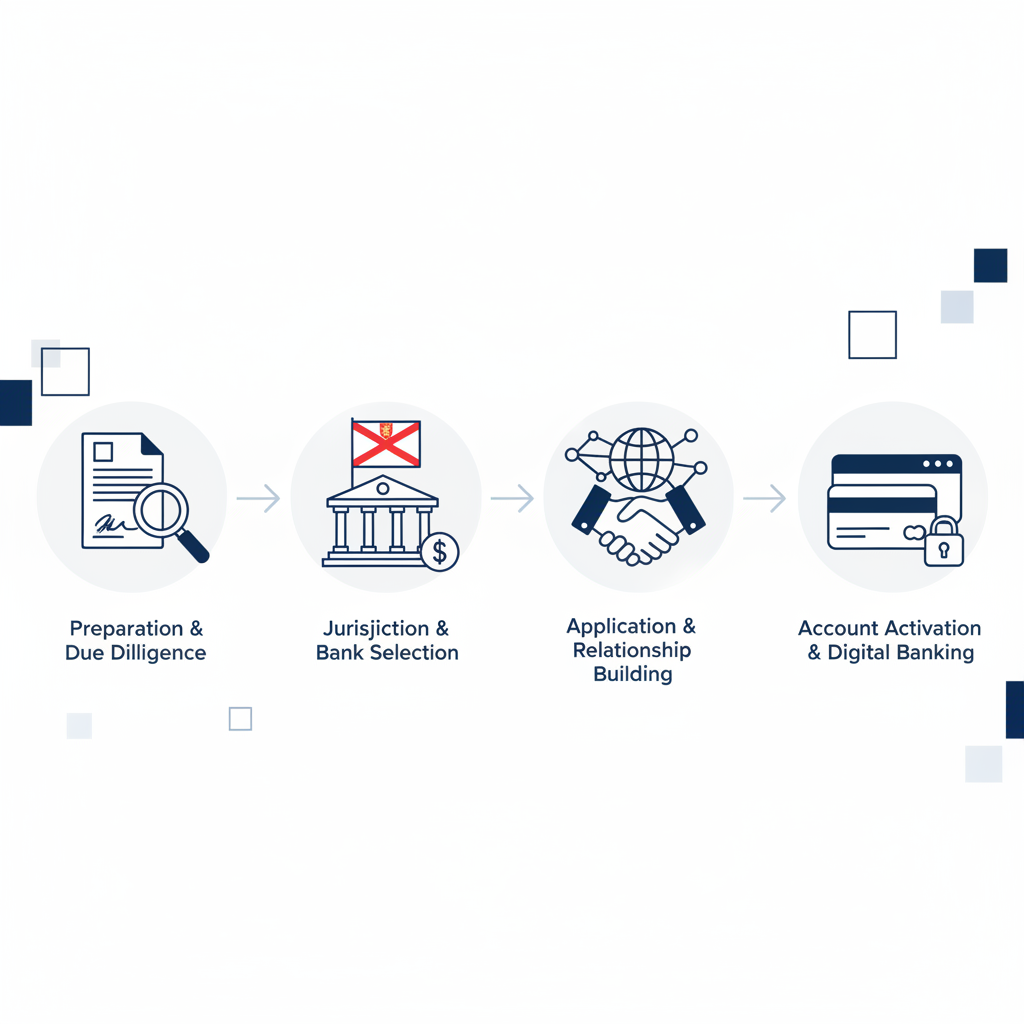
The Account Opening Process: A Step-by-Step Guide
Opening a corporate bank account in Jersey typically involves several stages, each requiring diligent attention to detail. The process is heavily influenced by 'Know Your Customer' (KYC) and Anti-Money Laundering (AML) regulations, which are strictly enforced.
Step 1: Initial Research and Bank Selection
The first crucial step is to identify a bank that aligns with your business needs. Jersey hosts a variety of international banks, each with different specialisms, service offerings, and client profiles. Consider factors such as:
- Bank's Specialisation: Does the bank cater to businesses of your size, industry, and complexity (e.g., e-commerce, funds, holding companies)?
- Service Offerings: What specific services do you require (e.g., multi-currency accounts, trade finance, online banking, treasury services)?
- Fees and Charges: Understand the fee structure for account maintenance, transactions, and international transfers.
- Minimum Balance Requirements: Some banks may have significant minimum deposit or balance requirements.
- Client Support: Assess the quality and responsiveness of their customer service.
It is advisable to contact several banks directly or through a professional intermediary to discuss your requirements and obtain preliminary information.
Step 2: Pre-Application and Due Diligence Requirements
Once you have shortlisted potential banks, you will typically undergo a pre-application screening. This involves providing initial information about your company and its activities. The bank will then provide a comprehensive list of required documents for their due diligence (KYC/AML) process. This is the most critical and often the most time-consuming part of the application. Expect to provide:
- Company Documents:
- Certificate of Incorporation (or equivalent)
- Memorandum and Articles of Association (or equivalent constitutional documents)
- Register of Directors and Shareholders
- Proof of registered office address
- Certificate of Good Standing (if applicable)
- Business Plan (detailing activities, source of funds, expected transaction volumes, and geographic reach)
- Audited financial statements (for existing businesses)
- Beneficial Owners and Directors (for each individual):
- Certified copy of passport or national ID card
- Certified proof of residential address (e.g., utility bill, bank statement, not older than 3 months)
- Curriculum Vitae (CV) or professional biography
- Source of wealth and source of funds declaration
- Bank reference letter
- Professional reference letter (e.g., from an accountant or lawyer)
All documents must be certified by a recognised professional (e.g., lawyer, notary public, or accountant) and, if not in English, accompanied by a certified translation. The bank will scrutinise these documents to understand the company's structure, its ultimate beneficial owners, the nature of its business, and the legitimacy of its funds.
Step 3: Application Submission and Review
After gathering all necessary documentation, you will formally submit your application. This often includes completing extensive application forms provided by the bank. The bank's compliance team will then conduct a thorough review of all submitted information. This stage involves:
- Verification: The bank will verify the authenticity of all documents and information provided.
- Risk Assessment: An assessment of the company's risk profile, including geographical risk, industry risk, and the risk associated with the beneficial owners.
- Clarification Requests: It is common for banks to request additional information or clarification during this phase. Prompt and comprehensive responses are crucial to avoid delays.
- Interview (Optional): In some cases, the bank may request an interview with the directors or beneficial owners, either in person or via video conference.
Step 4: Account Approval and Activation
Upon successful completion of the due diligence process and approval by the bank's internal committees, you will receive notification of account opening. This will be followed by the provision of account details, online banking access, and any other agreed-upon services. Initial funding instructions will also be provided. It's important to note that some banks may require an initial deposit to activate the account.
Timelines, Costs, and Challenges
Timelines:
The timeline for opening a corporate bank account in Jersey can vary significantly. While a straightforward application might be processed within 4-6 weeks, more complex structures, or those involving multiple jurisdictions or higher risk factors, could take 3-6 months or even longer. Delays are most commonly caused by incomplete documentation, slow responses to bank queries, or complexities in verifying the source of funds or wealth.
Costs:
Costs associated with opening and maintaining a corporate bank account in Jersey include:
- Bank Application Fees: Some banks may charge an upfront application or due diligence fee, typically ranging from a few hundred to several thousand pounds, depending on the complexity.
- Account Maintenance Fees: Monthly or quarterly fees for keeping the account active.
- Transaction Fees: Charges for incoming and outgoing transfers, particularly international payments.
- Professional Fees: Costs for legal or corporate service providers who assist with the application, document certification, and ongoing compliance.
It is essential to obtain a clear fee schedule from your chosen bank upfront.
Common Challenges and How to Overcome Them:
- Incomplete Documentation: Ensure all documents are precisely as requested, certified correctly, and up-to-date. Create a checklist and double-check everything before submission.
- Lack of Transparency: Banks require a clear understanding of your business model, source of funds, and ultimate beneficial ownership. Be prepared to provide detailed explanations and supporting evidence.
- High-Risk Jurisdictions/Activities: If your business operates in or deals with jurisdictions deemed high-risk by international standards, or if your business activities are considered high-risk (e.g., cryptocurrency, gambling), expect enhanced due diligence and potentially longer processing times or even refusal.
- Absence of Local Presence: While not always mandatory, having a demonstrable link to Jersey (e.g., through a local corporate service provider, director, or registered office) can sometimes streamline the process, though many banks are accustomed to dealing with purely international clients.
Engaging Professional Assistance
Given the stringent regulatory environment and the detailed nature of the application process, many businesses opt to engage professional assistance. Corporate service providers, lawyers, or specialist consultants in Jersey can offer invaluable support by:
- Advising on Bank Selection: Helping you choose the most suitable bank for your specific needs.
- Document Preparation: Assisting in gathering, reviewing, and certifying all required documentation to ensure compliance.
- Liaison with Banks: Acting as an intermediary, facilitating communication, and addressing queries efficiently.
- Structuring Advice: Providing guidance on corporate structuring to meet regulatory requirements and business objectives.
While this adds to the overall cost, it can significantly reduce the time and effort involved, minimise the risk of errors, and increase the likelihood of a successful application.
Conclusion
Opening a corporate bank account in Jersey is a strategic decision that offers access to a highly reputable and stable financial jurisdiction. While the process demands thorough preparation and adherence to stringent KYC/AML regulations, understanding each step and being proactive in providing comprehensive documentation can streamline the experience. By carefully selecting the right banking partner, meticulously preparing all required information, and considering professional assistance, businesses can successfully establish a robust banking relationship in Jersey, paving the way for efficient international operations and financial management. The investment in time and resources during the application phase is a testament to Jersey's commitment to financial integrity, ultimately benefiting businesses seeking long-term stability and security for their financial assets.