Opening a Corporate Bank Account in the United States: A Comprehensive Step-by-Step Guide for Businesses
Navigating the complexities of opening a corporate bank account in the United States is a critical step for any business, whether domestic or international. This guide provides a detailed, step-by-step overview of the process, outlining essential requirements, regulatory considerations, and practical advice to ensure a smooth and efficient setup.
Opening a Corporate Bank Account in the United States: A Comprehensive Step-by-Step Guide for Businesses
Establishing a corporate bank account in the United States is a foundational requirement for any business operating within or looking to access the U.S. market. This crucial step enables businesses to manage finances, process transactions, pay employees, and comply with tax obligations. While the process might seem straightforward, it involves several critical considerations, especially for international entities or those new to the U.S. regulatory landscape. This guide will demystify the process, offering a clear, actionable roadmap for entrepreneurs and business professionals.
Understanding the Landscape: Why a U.S. Corporate Bank Account is Essential
A U.S. corporate bank account is more than just a place to hold funds; it's a gateway to operational efficiency and credibility. For domestic businesses, it separates personal and business finances, simplifying accounting, tax preparation, and demonstrating professionalism. For international businesses, it facilitates transactions with U.S. customers and suppliers, avoids costly international transfer fees, and often enhances trust and legitimacy among U.S. partners. Furthermore, many payment processors and e-commerce platforms require a local U.S. bank account for payouts.
Key Benefits:
- Operational Efficiency: Streamlined payments, payroll, and expense management within the U.S. financial system.
- Cost Savings: Reduced foreign exchange fees and international wire transfer costs.
- Credibility: Enhances business legitimacy and trust with U.S. clients, vendors, and investors.
- Compliance: Easier adherence to U.S. tax regulations and financial reporting standards.
- Access to Services: Eligibility for U.S.-based credit, loans, and other financial products.
Prerequisites: What You Need Before You Start
Before approaching a bank, ensure your business has met several fundamental prerequisites. These are non-negotiable and form the bedrock of your application.
1. Business Legal Entity Formation
Your business must be legally registered in the United States. This typically means forming an LLC (Limited Liability Company), C-Corp, or S-Corp in a U.S. state. The state of formation doesn't necessarily dictate where you open your bank account, but it must be a recognized U.S. entity. For international businesses, this often involves registering a U.S. subsidiary or branch.
2. Employer Identification Number (EIN)
The EIN, also known as a Federal Tax Identification Number, is a unique nine-digit number assigned by the Internal Revenue Service (IRS) to identify a business entity. It's akin to a Social Security Number for individuals and is mandatory for opening a business bank account, filing taxes, and hiring employees. You can apply for an EIN online, by fax, or by mail. Non-U.S. residents without a Social Security Number (SSN) or Individual Taxpayer Identification Number (ITIN) can still apply for an EIN by fax or mail, though this process can take several weeks.
3. Registered Agent and Physical Address
Most states require businesses to have a registered agent – an individual or entity designated to receive legal documents on behalf of the business. While not always a direct bank requirement, having a U.S. physical address (not just a P.O. box) is often crucial for banks to establish your business's presence and for KYC (Know Your Customer) purposes. Some banks may accept virtual office addresses, but this varies significantly.
4. Business Documents
Prepare all relevant legal and formation documents. These include:
- Articles of Incorporation/Organization: Proof of your business's legal existence.
- Operating Agreement (for LLCs) or Bylaws (for Corporations): Outlines the ownership structure and operational rules.
- Business Licenses and Permits: Any specific licenses required for your industry or location.
- Resolution of the Board of Directors (for Corporations): Authorizing specific individuals to open and manage the bank account.
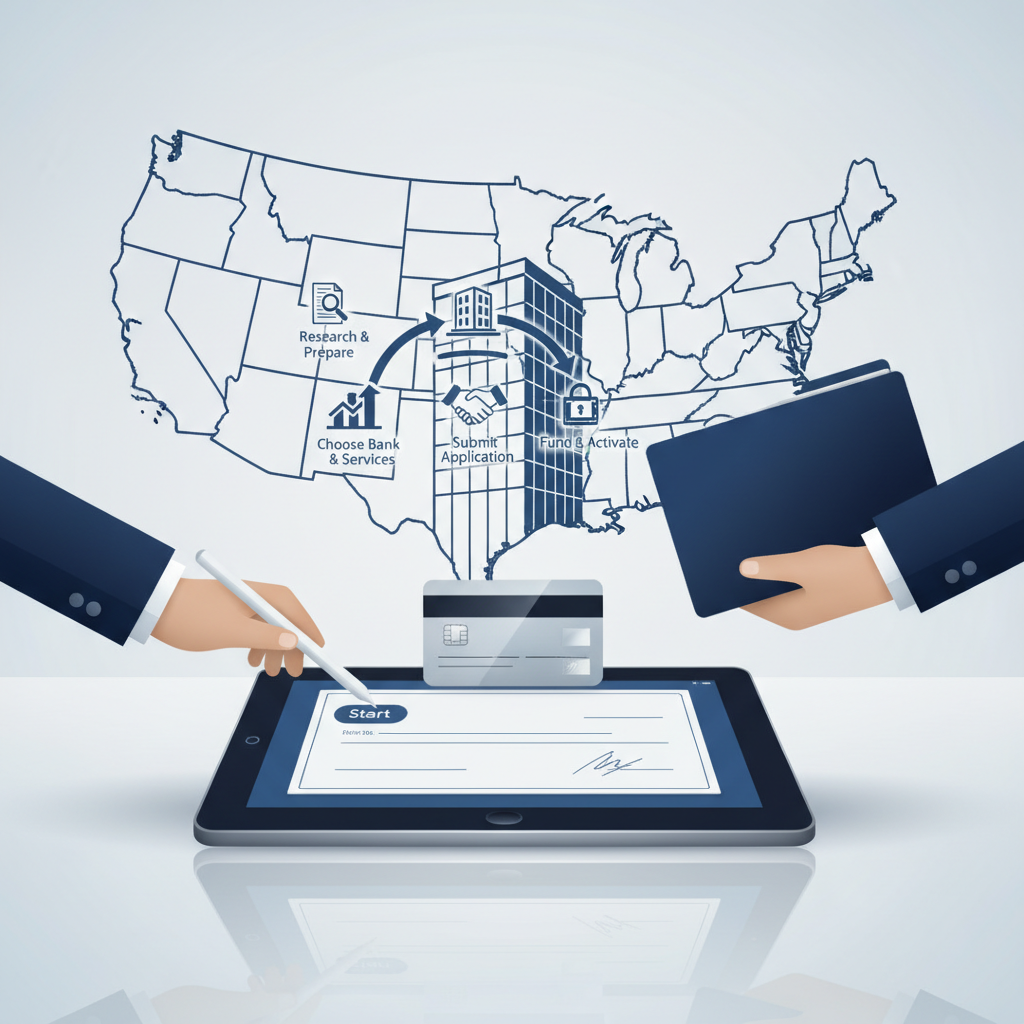
The Application Process: Step-by-Step Guide
Once you have all prerequisites in order, you can proceed with the bank account application. The process can vary slightly between banks, but the core steps remain consistent.
Step 1: Choose the Right Bank
Selecting a bank is a critical decision. Consider factors such as:
- Fees: Monthly maintenance fees, transaction fees, wire transfer fees, and ATM charges.
- Services Offered: Online banking, mobile banking, payroll services, merchant services, lines of credit, international banking capabilities.
- Minimum Balance Requirements: Some accounts require a minimum balance to waive fees.
- Branch Network: If you require in-person services, consider banks with convenient branch locations.
- Customer Service: Responsiveness and support for business clients.
- International Business Support: For foreign-owned businesses, some banks specialize in supporting non-resident owners.
Popular choices include large national banks (e.g., Chase, Bank of America, Wells Fargo) for their extensive networks and services, and regional or community banks for more personalized service. Fintech banks (e.g., Mercury, Brex) also offer compelling options, particularly for tech-focused businesses, often with streamlined online application processes.
Step 2: Gather Required Documentation (Personal & Business)
Banks are subject to stringent anti-money laundering (AML) regulations under the Bank Secrecy Act (BSA) and the PATRIOT Act, necessitating thorough due diligence. You will need to provide:
- Business Documents: EIN confirmation letter, Articles of Incorporation/Organization, Operating Agreement/Bylaws, business licenses.
- Proof of Business Address: Utility bill, lease agreement, or other official document showing your U.S. business address.
- Personal Identification for Account Signatories: Valid government-issued photo ID (e.g., passport, U.S. driver's license) for all individuals authorized to sign on the account. For non-U.S. residents, a valid passport is typically required.
- Proof of Address for Account Signatories: Utility bill, bank statement, or lease agreement (personal address).
- Business Plan (Optional but Recommended): Especially for new or international businesses, a well-structured business plan can help banks understand your operations and financial needs.
Step 3: Schedule an Appointment or Apply Online
Many traditional banks still prefer an in-person visit to open a business account, especially for international owners or complex structures. This allows them to verify identities and documents directly. However, an increasing number of banks and fintech platforms now offer fully online application processes, which can be significantly faster. Be prepared for a video call verification if applying remotely.
Step 4: Complete the Application Form
The application will require detailed information about your business, its ownership structure, the nature of its operations, and expected transaction volumes. Be accurate and thorough. Banks will assess the risk associated with your business based on this information.
Step 5: Fund the Account
Once approved, you'll need to make an initial deposit to activate the account. The minimum deposit varies by bank and account type.
Challenges and Considerations for International Businesses
Opening a U.S. corporate bank account as a non-U.S. resident or foreign-owned entity presents unique challenges:
- Physical Presence Requirement: Many traditional banks historically required an in-person visit by a signatory to open an account. While this is changing, it remains a hurdle for some.
- Proof of Address: Providing a verifiable U.S. business address and personal address for non-residents can be difficult.
- KYC/AML Scrutiny: International businesses often face heightened scrutiny due to AML regulations. Be prepared to provide extensive documentation and answer detailed questions about your business's beneficial owners and source of funds.
- ITIN Requirement: Some banks may request an ITIN for non-resident beneficial owners, even if they have an EIN for the business. This is not universally required but can arise.
- Limited Options: Certain banks are more amenable to working with international clients than others. Research banks that explicitly cater to foreign-owned businesses or non-resident entrepreneurs.
Fintech solutions have emerged as a popular alternative for international businesses, often offering fully remote application processes and more flexible requirements for non-resident owners, provided the underlying U.S. entity and EIN are in place.
Costs and Timelines
Costs:
- Account Fees: Monthly maintenance fees (often waivable with a minimum balance), transaction fees, wire transfer fees.
- Formation Costs: Costs associated with forming your U.S. legal entity (e.g., state filing fees, registered agent services).
- EIN Application: Free if done directly with the IRS.
Timelines:
- Entity Formation: 1-5 business days (expedited options available) to several weeks depending on the state.
- EIN Application: Immediately online (if eligible), or 2-4 weeks by fax/mail for non-residents.
- Bank Account Opening: From a few hours to a few days for domestic businesses with all documents ready. For international businesses, it can range from a few days with fintech banks to several weeks with traditional banks, especially if an in-person visit or extensive due diligence is required.
Conclusion
Opening a corporate bank account in the United States is a fundamental step for any business aiming to operate effectively within the U.S. economy. While the process requires careful preparation and adherence to regulatory requirements, particularly for international entities, it is entirely manageable. By understanding the prerequisites, gathering the necessary documentation, and choosing a bank that aligns with your business needs, you can navigate this process smoothly. A well-established U.S. bank account not only facilitates financial operations but also solidifies your business's presence and credibility, paving the way for growth and success in one of the world's largest markets. Prioritize due diligence, be thorough in your application, and don't hesitate to seek professional guidance if your business structure presents unique complexities.